Hotel website design: how a boutique hotel website wins direct bookings
Good hotel website design has one job: turning lookers into direct bookings. The site has to show rooms and place better than an OTA listing, load fast on a phone, and put a Book Now button one tap away. It matters because online travel agencies still take a large share: in the US, hotels account for 63% of OTA gross bookings, according to Phocuswright.
- US online travel agencies booked $100.3 billion in 2025, and hotels made up 63% of it (Phocuswright, via Hospitality.today).
- Travelers comparison shop hard, so your site is where they choose between your direct rate and an OTA rate.
- Three priorities: visuals that make people feel the place, a fast mobile page, and a booking button on every screen.
- No website replaces OTAs overnight. The realistic goal is to win back a share of bookings, not all of them.
Why does a hotel still need its own website if it is on Expedia and Booking.com?
Because every booking that goes through an online travel agency (OTA) carries a commission, and the guest relationship belongs to the platform. The channel is not shrinking. According to Phocuswright's US Online Travel Agency Market Essentials 2026, as reported by Hospitality.today:
- US OTA gross bookings rose 4% in 2025 to $100.3 billion;
- hotels account for 63% of those OTA bookings, while air is 20% and falling;
- OTAs take about a fifth of all US travel gross bookings, projected to reach 21% by 2028.
That is the market a boutique hotel website competes in. If your own site is slower, blander, or harder to book than your listing on a big platform, the guest has no reason to book with you. If it shows the property better and makes booking just as easy, you give them one.
How do travelers choose a hotel online?
They shop around, a lot. Expedia Group Media Solutions data reported by Travel Market Report found that travelers visit 277 websites before booking travel, up from 38 in 2013, and spend an average of 303 minutes on it in the 45 days before they book.
Visuals carry much of that decision. A 2014 TripAdvisor study covered by Hospitality Net ranked photo count as the top driver of traveler engagement: properties with more than 100 photos were 238% more likely to receive a booking inquiry than properties with none. The study is old and it measured TripAdvisor listings, not hotel websites, so treat it as a signal rather than a forecast. The signal is clear anyway: guests look before they read.
Your website is often the last page a guest sees before deciding. It is where they check the view from the room, the breakfast space, the walk to the beach. A thumbnail grid that looks exactly like your OTA listing adds nothing. A page that moves them through the property, room by room, does.
What should a boutique hotel website include?
- A Book Now button on every screen, wired to your booking engine (the tool that shows live rates and availability).
- Each room type on its own: size, bed, view, amenities, and several images per room.
- The neighborhood: parking, distance to the beach or downtown, what to do nearby.
- Clear reasons to book direct: flexible cancellation, breakfast, a room upgrade, a real person to call. Only promise what you actually deliver.
- A mobile-first layout, because much of the research happens on a phone.
- Practical details that Google and AI assistants can read: address, check-in and checkout times, phone number, languages spoken.
Does page speed really matter for a luxury hotel website?
Yes, and there is data on it. Google's report The Need for Mobile Speed, based on 2016 Google Analytics benchmark data, found that 53% of visits are abandoned if a mobile site takes more than three seconds to load. A later study commissioned by Google and run by 55 and Deloitte, published on web.dev, looked at more than 30 million sessions across 37 European and American brands. For travel sites, a 0.1 second improvement in mobile load times came with a 10% increase in booking rates and a 2.2% increase in completed checkouts.
Luxury hotel websites fall into a familiar trap here: heavy autoplay video that looks great on office Wi-Fi and crawls on a guest's phone in a rental car. The design has to impress without slowing the page. That is a technical constraint to set on day one, not a fix after launch.
Hotel website design options: templates, agencies, or something else?
There is no single right answer. Here is an honest comparison, including doing it yourself.
| Option | What you get | Trade-offs | Best for |
|---|---|---|---|
| OTA listings only | Instant reach, no site to maintain | Commission on every stay, the platform owns the guest, you look like every competitor | New openings, testing a market |
| DIY hotel website template (Squarespace, Wix, WordPress) | Full control, low software cost | Your time, a look shared by thousands of sites, speed and search visibility are on you | Tech-comfortable owners with time |
| Website bundled with your booking engine | Built-in booking, quick setup | Rigid templates, little room for brand identity | Small properties that need the basics |
| Hotel website design agency | Custom design, hands-on support | Longer timelines, budget depends on the quote | Groups, properties with a detailed brief |
| Allure cinematic site | Your existing photos staged as a scroll that moves through the property | Does not replace your booking engine or your OTA listings | Boutique hotels where the place itself is the selling point |
How does Allure build a hotel website?
Allure starts from a simple observation: most hotels already have photos, often good ones, shown in a flat gallery. The work is staging those images, not booking a new shoot.
- We collect your existing photos from your current site, listings, and folders.
- We build the cinematic scroll: the page moves like a camera, from the entrance to the rooms.
- Check that the Book Now button leads to the booking engine you already use.
- If speed matters most, a single home page can go live in 48 hours.
What is proven, and what is not
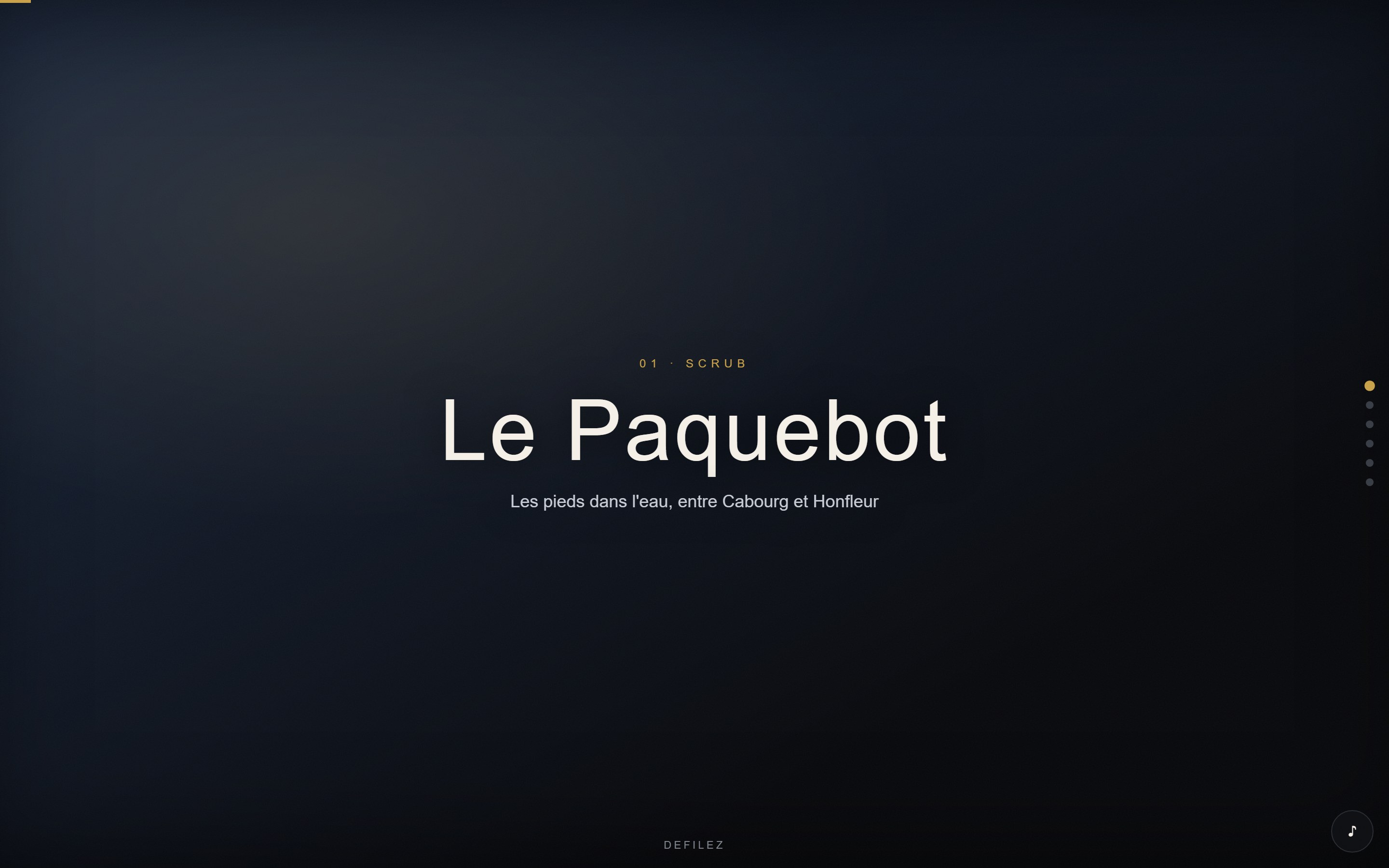
What you can check yourself today: the Le Paquebot demo, a hotel in Villerville on the Normandy coast of France, between Cabourg and Honfleur, shows how the site behaves on a phone and on a desktop. Every number in this article comes from a source linked at the bottom of the page.
What we do not claim: a percentage of direct bookings you will win. We have no public measurement to show you on that, and no hotel website design company can honestly promise that number before it has seen your traffic, your rates, and your OTA mix. Be wary of anyone who does.
Hotel website design FAQ
How much does hotel website design cost?
It depends on the number of pages and languages and on the booking engine you need to connect, and quotes vary widely between providers. Allure pricing is listed on our English home page. Always compare like for like: languages, photography, hosting, and maintenance included or not.
Can a hotel website replace Expedia and Booking.com?
Not completely. Phocuswright data shows hotels still make up 63% of US OTA gross bookings, and those platforms bring visibility. Your website exists to win back a share of bookings, especially from guests who already found you.
Does a hotel website need a booking engine?
Yes, if you want online reservations. Without one, guests have to call or email, and some of them will not bother. Whatever design you choose, check that the Book Now button leads to live rates and availability in one tap.
What is the best hotel website design?
The one that turns visits into direct bookings, which is not always the flashiest. It loads fast on a phone, shows each room in detail, keeps a booking button on every screen, and gives guests a real reason to skip the OTA.
Do I need new professional photos for a luxury hotel website?
Not necessarily. If your current photos are sharp and cover the rooms, common areas, and exterior, they can be restaged. A new shoot makes sense only when important spaces are missing.
Should I use a hotel website template or hire a hotel website design agency?
A template works if you have the time and skills to run it, but it will look like many other sites. An agency gives you a custom result with longer timelines. A cinematic site built from your existing photos sits in between: distinctive, without a new shoot.
See it before you decide
Our hotel demo, Le Paquebot, is public: open it on your phone and scroll. Demos for other industries are on the demos page, and pricing is listed on the English home page. If you want a walkthrough for your own property, ask for one.
Sources
- Hospitality.today, July 24, 2026, citing Phocuswright US Online Travel Agency Market Essentials 2026
- web.dev (Google), Milliseconds make millions case study, research by 55 and Deloitte, data from late 2019
- Google (Think with Google), The Need for Mobile Speed, 2016, Google Analytics benchmark data from March 2016
- Travel Market Report, September 3, 2024, Expedia Group Media Solutions data (Path to Purchase 2023)
- Hospitality Net, September 4, 2014, TripAdvisor study on photos and booking inquiries